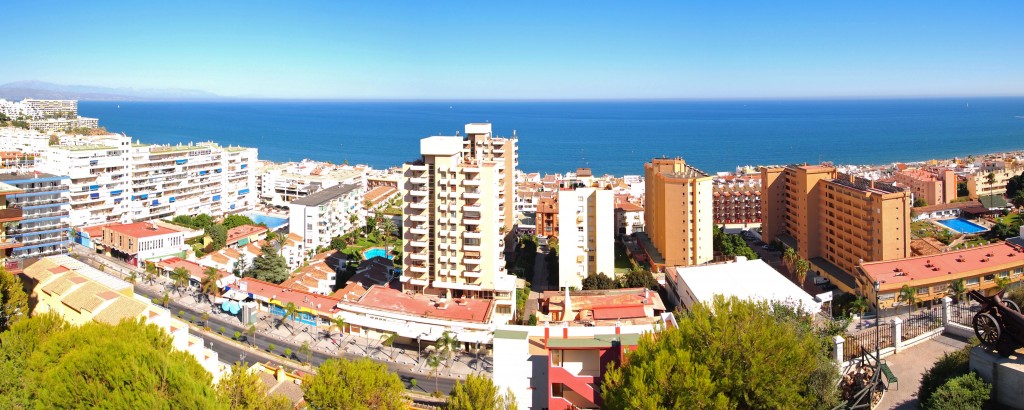
We continue with our tourist route through the province of Malaga… today we move a little to the west of the province to visit Torremolinos, a town that went from being exclusively for humble fishermen to being one of the main tourist destinations in Spain. Do you want to know what wonders this coastal town hides? Read!
Located just 13 km from the centre of Malaga city, Torremolinos became part of the city from 1924 to 1988. Until the 50s it was a small fishing village that, suddenly, became the first sun and beach tourist destination in Andalusia, and one of the first in Spain. Proof of fact is an incredible demographic growth: from barely 3000 people registered in the municipality in 1920 to more than 67,000 now (a number that is multiplied in the summer months).
Three things characterize Torremolinos:
- The diversity of its neighborhoods. It consists of 8 neighborhoods very different from each other, perhaps due to the time difference in which they were built, attending to the demand due to the growing demographics. Los Álamos (the most modern area of the town, where the nightlife is concentrated, especially in the summer months), La Colina (neighborhood of people who usually live here all year round, it does not have a beach area although it is close to Los Álamos beach), Playamar (beach area a little more familiar and more national tourism than in the rest of the beaches of the municipality, being less touristy), El Bajondillo (one of the two oldest neighborhoods, its old buildings are characteristic), El Calvario (third neighborhood that appeared in the town and that makes up the urban center, a little further away from the tourist area), La Carihuela (the second of the oldest neighborhoods and perhaps the most picturesque and characteristic of Torremolinos, everything here is reminiscent of the times when only humble fishermen lived), Montemar and El Pinillo (both more modern residential areas).
- The mixture of cultures. Up to 130 nationalities in a town of less than 68,000 inhabitants. The foreign population registered in Torremolinos represents 26% of the total, almost all from Germany, the Netherlands, France, Scandinavia and the United Kingdom. Although the number of Torremolinos from Morocco, Latin America and China is growing.
- GLBT Tourism. Torremolinos is a destination for LGBT (Lesbian, Gay, Bisexual and Transsexual) tourism recognized all over the world. In fact, the first gay bar in Spain was opened here in 1962, Toni’s Bar.
If you are thinking of spending a few days in Torremolinos or you live nearby and want to get to know this touristy town, we leave you with some essential visits that you cannot miss:
- San Miguel Street. It is the main shopping street of the municipality, where you can find numerous shops and businesses of well-known brands. The street starts in the old town and reaches the coast, to the neighborhood of El Bajondillo. This is where the Torre Molinos is located, the defense tower that gives the municipality its name.
- Hotel Pez Espada. Declared an Asset of Cultural Interest. It was inaugurated on May 31, 1959 as a 5-star hotel (it currently owns 4), the first luxury hotel on the entire Costa del Sol. In its rooms have slept well-known characters such as Sean Connery, America’s bride Mary Pickford, King Juan Carlos I of Spain, King Faisal of Saudi Arabia, Sofia Loren, Frank Sinatra, Julio Iglesias, Ava Gardner, etc.
- House of the Navajas. Private house of an important businessman from Churriana dedicated to the cultivation of sugar cane in the area of the current Malaga airport. Construction began in 1925 and in 1991 it was declared of Historical Interest by the Ministry of Culture of the Junta de Andalucía. It currently belongs to the Torremolinos City Council and its re-opening took place just a year ago.
- Church of San Miguel. Built in 1718, located in the Plaza de los Santos Arcángeles.
- Church of the Virgen del Carmen. It houses the image of the Virgen del Carmen, patron saint of the municipality.
- Molino de Inca Botanical Garden. An essential place for nature lovers, this place is home to more than 150 palm trees of different types, about 300 trees and 400 different shrubs.
- Battery Park. For an afternoon with the family, the Battery Park is undoubtedly the perfect place! Recreation area with attractions for children, a navigable central lake and a lookout tower. In addition, it is located on land that was an area of anti-aircraft batteries used in the Civil War, so you can visit passageways and “secret” bunkers.
- If there is one thing that characterizes Torremolinos, it is its 7 km of beaches: Los Álamos, Playamar, El Bajondillo, La Carihuela, Montemar and El Saltillo. Enjoy its waters, its promenade and a good plate of fried fish.
And to have perfect days, make sure you sleep in a good hotel with a good mattress. We propose some that we are 100% that will make your visit very pleasant: Hostal Guadalupe, a small and cozy accommodation in the heart of the center and very close to the beach; Hotel Riu Costa Lagos, an exclusive resort with swimming pool, spa, nursery, buffet, etc. just 150 m from the beach; Hotel Amaragua, a classic hotel on the Costa del Sol with gym, spa and beachfront, in the typical neighborhood of La Carihuela; the Palace Costa del Sol Hotel, a very interesting themed hotel; Hotel Arco de Montemar, located in La Carihuela, just 200 metres from the beach. Finally, if you want to spend a few days in a building with a lot of history, we recommend the Hotel Residencia Miami, an example of the most eccentric style of relaxation : ashlar façade, Gothic arch, Greco-Roman mosaic flooring, swimming pool surrounded by a tropical garden, etc. A palace from the 50s ordered to be built by the great dancer Lola Medina and decorated by Manuel Blasco, Picasso’s cousin. Lola Medina turned it into her summer residence until she was forced to sell it to Mercedes Gómez Delgado, who decided to convert the house into a hotel, being the first hotel in La Carihuela (it was opened even before the Pez Espada hotel).
So now you know, visit Torremolinos and relive the glamour that was experienced in its streets in the 50s.