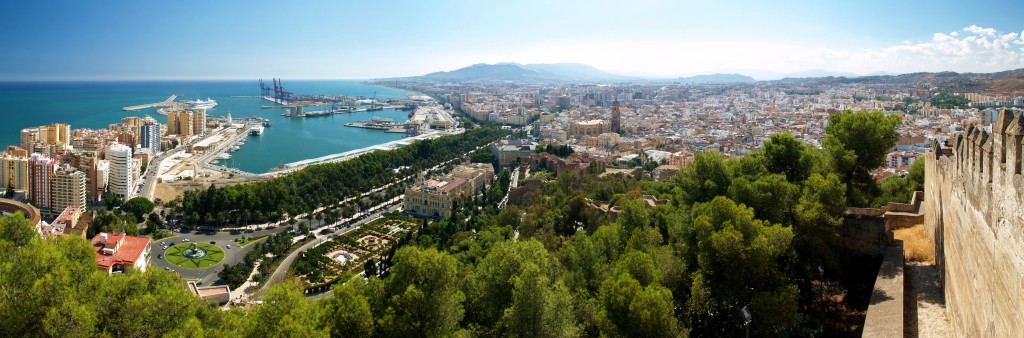
Malaga… Andalusian city located at the western end of the Mediterranean Sea, about 100 km from the Strait of Gibraltar, on the so-called Costa del Sol. It has more than 572,900 inhabitants, making it the sixth most populous city in Spain and the second most populous in Andalusia.
With a subtropical-Mediterranean climate, any time of the year is good to visit, with the average annual temperature being 18.5 °C.
Malaga is characterised by the proximity of the Mediterranean Sea, the Guadalmedina river (which crosses the city) and the proximity of the Montes de Málaga, which makes the eastern part of the city narrow and long and “enclosed” between the sea and the mountains.
Malaga has been declared a Historic Site due to the traces left by numerous civilizations throughout history. That said, you will assume that the tourist attractions are innumerable. We have tried to make a selection and leave you with these 10 must-sees in Malaga:
- Malaga Park and Alameda Principal. Alameda Park, better known simply in the city as El Parque, is located in the center of the city. It is a landscaped promenade that is reminiscent of the walks of the Baroque and Renaissance periods. You can find numerous subtropical species here, making it one of the most interesting public parks in Europe. In addition, along the promenade you will be able to see different points of interest such as the Customs Palace, the old House of the Chief Gardener, the old Post Office building, the headquarters of the Bank of Spain and the City Hall. And at the end of the walk in the Plaza del General Torrijos, in the well-known neighborhood of La Malagueta, you will find the Plaza de Toros de la Malagueta.
- Marqués de Larios Street. It is the nerve centre of the city. It was inaugurated in August 1891, being blessed by the bishop of the diocese Marcelo Spínola y Maestre. It is the fifth most expensive shopping street in Spain, only surpassed by Portal del Ángel, Preciados, Serrano and Paseo de Gracia streets, all located in either Barcelona or Madrid. This also makes it the most expensive shopping street in Andalusia.
- Port of Malaga. The Port of Malaga is one of the 10 largest ports in Spain and the second largest cruise port in the entire Iberian Peninsula, behind the Port of Barcelona. It is a commercial, passenger, cruise, marina and fishing port. It is worth strolling through the Port, contemplating its continuous activity, having a coffee in one of its many cafes and doing some shopping on Pier 1. Also interesting is its lighthouse, located at the entrance and called La Farola, the only lighthouse in Spain next to La Farola del Mar (Santa Cruz de Tenerife) with a female name.
- Picasso Birthplace and Museum. If there is one thing that characterises Malaga, it is that it has been the birthplace of one of the best painters in history: Pablo Picasso. For this reason, part of the city’s tourist activity is based on getting to know the places that the painter of Guernica frequented. Picasso’s Birthplace is located in the Plaza de la Merced and here you can enjoy family memories of the painter, as well as the work of José Ruiz Blasco, Picasso’s father and also a painter and professor at the School of Fine Arts in Malaga. The Picasso Museum Malaga brings together 285 works ranging from his early academic studies to the latest paintings of the 70s. It is located in the Palace of the Counts of Buenavista.
- Alcazaba. A palatial fortification from the Muslim period built on a Phoenician-Punic fortification. It currently extends over 15,000 square meters, not even half of what it measured at the time of construction. Among its rooms you can enjoy the Plaza de Armas (a flat area from which almost the entire city is dominated and where the artillery was installed), the Puerta de los Arcos (through which you could access a kind of dungeon where Christians who worked during the day were locked up at night), the Rooms of Granada (in which the kings and governors lived) and the Barrio de Viviendas and Torre del Homenaje (neighborhood formed by small houses with a small courtyard and some bedrooms).
- Roman Theatre. Ordered to be built by Emperor Caesar Augustus, it is located at the foot of Mount Gibralfaro and next to the Alcazaba. It distinguishes the stands (Cavea), the lowest stands for the authorities (Orchestra) and the stage (Proscaenium).
- Cathedral. The Holy Church Cathedral Basilica of the Incarnation is the city’s cathedral. It is located in front of the Plaza del Obispo and is one of the most valuable Renaissance jewels in Andalusia. It is located within the limits of the old Arab wall, where the Catholic Monarchs ordered it to be built days after the conquest. It is a mixture of different styles, although the Renaissance prevails. It is known as “La Manquita” since it was inaugurated unfinished, it lacked the finishing of the main façade and the completion of the south tower.
- Atarazanas Market. It is the current municipal market of the city. The building dates from 1876-1879 and was built on top of a Nasrid naval workshop, of which only the marble door is preserved and from which its name “Atarazana” comes.
- English Cemetery. Declared an Asset of Cultural Interest in 2012, the cemetery of San Jorge is a nineteenth-century cemetery located in the Cañada de los Ingleses. It is the first Protestant cemetery in Spain. It is a kind of botanical garden with benches overlooking the sea and exotic species that grow everywhere, mixing with the tombs with classical, neo-Gothic and modernist elements. One of the first graves in the cemetery was that of Robert Boyd, a young Irishman who accompanied Torrijos.
- Carmen Thyssen Museum. For art lovers, Malaga is also interesting. Housed in the Palacio de Villalón, it was inaugurated in March 2011 and in it you can find several rooms dedicated to the Thyssen Collection, a library, rooms for temporary exhibitions, a didactic classroom, an archaeological exhibition room, etc.
And after this sightseeing tour you will end up exhausted, so the best thing to do is to rest in one of its many hotels where you can sleep on one of our best mattresses.
If you are looking to sleep in a hotel we recommend the Hotel Atarazanas (C/Atarazanas, a few minutes from the Atarazanas Market), the Hotel Zenit (C/Cuba, is the closest hotel to the La Rosaleda Stadium), the Hotel California (Paseo Ancha, located in El Limonar, a very quiet area of Malaga and a few meters from the center), the Hotel Casa Vázquez (Camino del Colmenar, in Ciudad Jardín) or if you want a hotel close to the airport we recommend the Hotel Málaga Nostrum, just 5 minutes from it.
If you prefer cheaper accommodation but without neglecting some amenities, you can stay at Hostal Victoria, Feel Hostel City Center, Dulces Dreams Hostel, Hostal Capri or Hostal Moscatel. The first three are located in the heart of the city, at the foot of multiple points of interest.
And finally, if you are travelling with children we recommend the comfort of an apartment, such as the El Cenachero Apartments and the El Soho Apartments.
And if you want to visit us to change your mattress, you can find us in different parts of the city, check out our stores!
We are waiting for you in Malaga!