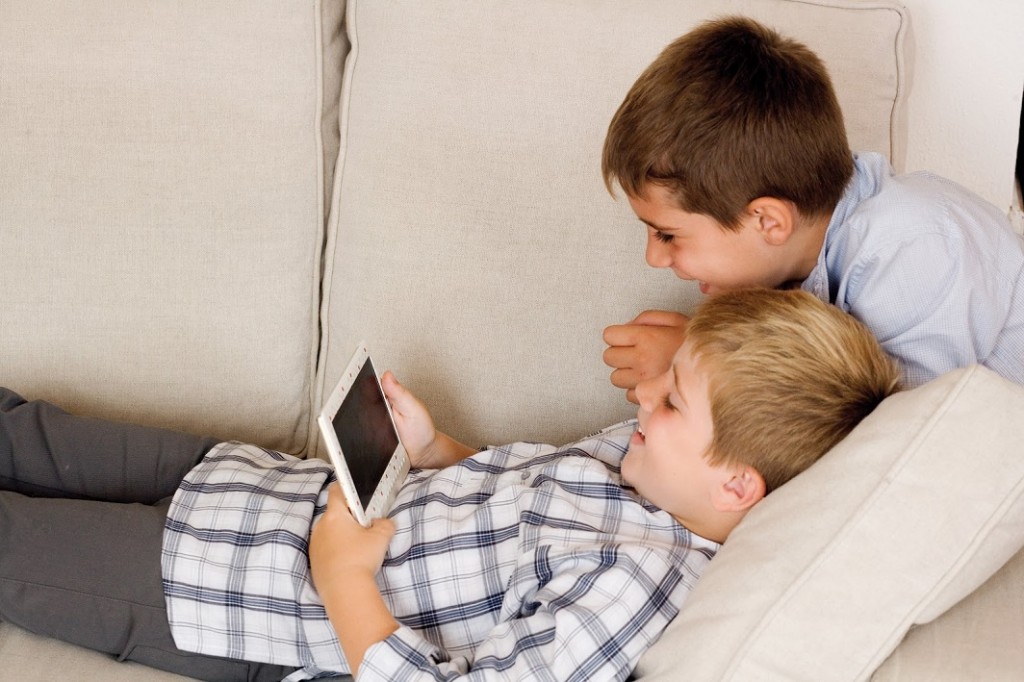
Experts say that the misuse of tablets and mobile phones before going to sleep has a negative effect.
Tuesday, 11:30 p.m. It’s time to go to sleep and once in bed Pedro, 16, takes one last look at his mobile phone. Follow a conversation with a friend, watch the trendy video or see what is the latest photo uploaded by your neighbor. A real shot of audiovisual stimuli.
This is the routine that thousands of people follow  Minors and adolescents before bedtime. The last thing they do before falling asleep is take a look at their tablets or smartphones. They have replaced books or a moment of conversation with solitude in front of the screens of their technological devices.
The consequences have not been long in coming and minors who have difficulty falling asleep are beginning to arrive at the consultations. “Technological insomnia” is one more in the room and children cannot fall asleep on time. Others, on the other hand, wake up at midnight and do not resume sleep easily. As a result, there has been an increase in the number of parents consulting GPs and sleep units in search of solutions.
Virginia Izura, a neurophysiologist at the Virgen de la Arrixaca Hospital and a specialist in sleep disorders, says that this new type of insomnia is very widespread. That it is coming to consultations more and more, but that in reality not all those who suffer from it do, generally because neither young people nor parents themselves are aware of it. “Of these cases, very few arrive at the sleep unit, many stay at the family doctor, but it is true that an increase is noticeable and it is a very important issue,” says Izura.
Some reports state that the profile of these minors is usually that of boys between 14 and 16 years old, and 98 percent of them, because they do not ensure that all of them, use technological devices the hour before sleep, even in the same bed. “In reality, it is not a difficult problem to eradicate. It’s a matter of habits and being strict with sleep hygiene measures, it can be solved only with a few tips from the doctor,” guarantees Izura, who does recognize “that it is usually common for the children we see to heed our advice, after we explain to them the scientific reasons why using cell phones and other devices before going to sleep is bad. They don’t pay attention to their parents, but they do to us.”
These scientific reasons for this type of “technological insomnia” are twofold. On the one hand, it has been shown that the artificial light from these devices, which are technically called screens with feedback light, alters the production of melatonin, which is the hormone that helps regulate our circadian rhythms (our internal clock) and help us fall asleep. “This delay in melatonin production in adolescents is very important and can have serious consequences for the rest of their lives, with serious insomnia problems,” says Izura. The second problem is that these devices activate neurons and we activate ourselves, which prevents us from falling asleep. “It is advisable not to use screens between one and two hours before going to sleep. It’s difficult, we’re all a little hooked on WhatsApp and stuff, but you have to try, especially the younger ones,” Izura adds.
Low school performance.
The first consequence of these bad habits is poor school performance. “Contrary to what happens to adults, children and adolescents who do not sleep well the next day are usually hyperactive, very agitated. And this causes them not to concentrate and their school performance drops,” she explains.
Several universities in the United States are already working on how the use of technology affects school performance, concentration and other habits, and some experts expect impressive results. All neurologists agree that it is essential that previous activity is carried out.
Unhealthy consequences
The mobile phone becomes one more extension of young people, who do not measure their use, generating consequences yet to be discovered.
First consequences linked to the use of the mobile phone before going to sleep
Sleep conciliation and maintenance disorders are beginning to be common in children who last look at their phone or tablet before sleeping. Episodes of nightmares or parasomnia (small sleep interruptions) are also associated.
What is the relationship?
Technological devices use backlit screens and activate areas of the brain that cancel sleep. The preceding activity should be quiet and induce sleep.
Consequences of suffering from sleep problems
The most immediate consequences in children and adolescents are related to their school performance. Lack of attention, concentration, irritability and tiredness to face the day is the most immediate thing in the face of nights with little rest. Hyperactivity is also associated.
What to do when this situation occurs?
They need to return to normality. When children go to the sleep unit, it is evaluated if there are more underlying problems related to the neurological or pneumological field. If not, the usual thing to do is to work to correct certain habits. With healthy routines, the problem should go away.
Source: La Opinión de Málaga