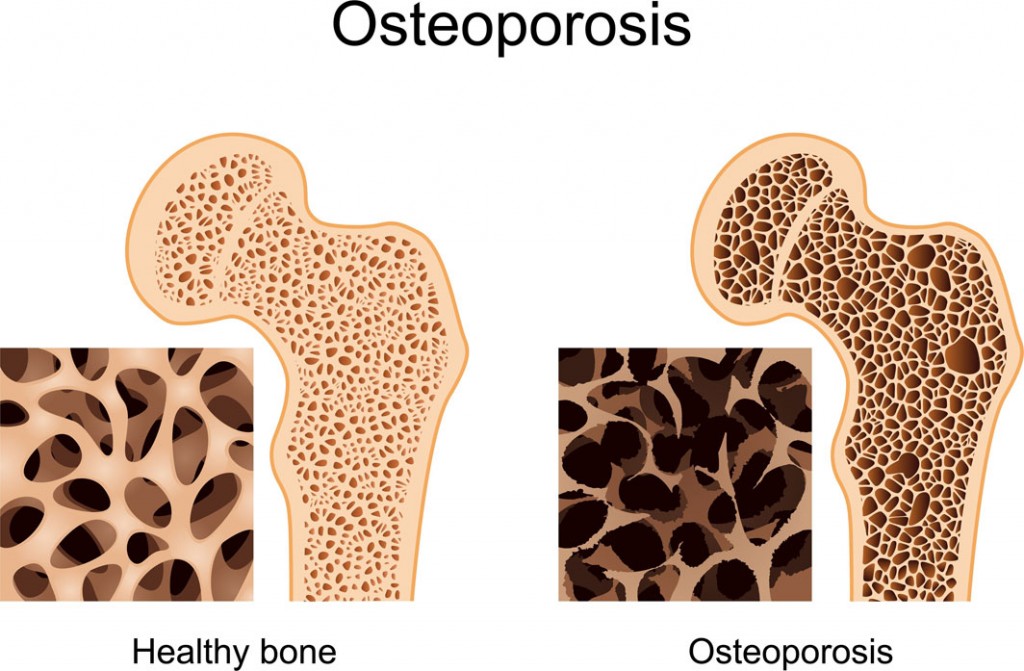
Osteoporosis is a disease that affects bones, making them more fragile and vulnerable to fractures or fissures. It usually attacks people over 50 years of age, especially women after menopause. They may suffer fractures of the hip, wrists or some of the vertebrae of the spine, after a blow, a fall or an effort.
Learn about the best exercises to prevent and treat osteoporosis.
What to know about osteoporosis
It is the most common type of bone disease. It increases the risk of broken and broken bones. Osteoporosis occurs when the body does not have the ability to make new bone. This disease is usually genetic, so it is inherited from parents to children. Other causes are not consuming the recommended amount of calcium, during life in general and menopause in particular.
Calcium and vitamin D are the nutrients we need to create new bone. If we do not consume them properly, then the bone structure becomes more fragile and, as a consequence, more prone to fractures or fissures.
Osteoporosis not only appears in women during menopause, but there may also be men who suffer from it after the age of 50, when the body stops producing so much testosterone (male hormone).
Other factors of this bone problem may include:
- Being bedridden.
- Some conditions.
- Taking certain medicines.
- Family history.
- Low body weight.
- A nutrient-deficient diet.
- Smoking.
- The absence of a menstrual period (amenorrhea).
As there are no symptoms in the early stages of osteoporosis, people do not realize that they suffer from it. Many times, it is diagnosed when the patient falls and breaks a bone. It can also cause unexplained pain, loss of height, or stooped posture (called kyphosis).
Exercises for osteoporosis
In addition to following a balanced diet, it is necessary to carry out certain activities to avoid suffering from osteoporosis in the future, or that the condition is not so serious. Bone metabolism will be increased by following a program of strength exercises that involve a moderate impact on the joints. It should include movements for both the upper and lower body.
It is also good to do aerobic exercise, such as walking, cycling, swimming, dancing or jogging (depending on the abilities of each person). In this way, an optimal cardiopulmonary system will be maintained as an additional benefit.
Before starting with the exercises, it is good to take into account the following recommendations:
- Do not fully flex your trunk, because you can damage your spine or even fracture it in the event that osteoporosis is advanced.
- Avoid holding your breath for a long time, better keep the rhythm constant.
- Perform three sets of 10 or 15 repetitions each, resting for a minute and a half between each set.
- These exercises should be carried out 3 to 5 times a week.
- Don’t forget to warm up beforehand and stretch well at the end of the routine.
Walk briskly for 15 minutes without stopping, if possible in a park (walking looking at shops or stopping at traffic lights does not count).
Lean on the back of the chair, standing, and bend one knee, partially, always keeping your back straight. Raise and lower your knee as far as you can.
Standing against the wall, with your hands resting, bring your body forward, so that it is diagonal, without lifting your feet or heels off the ground. Bend your elbows and bring your chest to where your hands are resting. Hold for a few seconds and return to the starting position.
Lean against the wall, standing but, this time, on your back. Spread your legs hip-width apart and bend your knees. Try to get up and down carefully.
Go up and down a step or steps. Another option can be to climb with the right foot, leave the left leg hanging in the air and return to the previous step. Then do the same with your left foot .
Sitting in a chair with his back firmly resting on the backrest, he brings his hands behind his head, at the height of the nape of his neck. Open your ribcage wide as you inhale and fill your lungs with air. Bring your elbows back as far as you can.
Also sitting, bring your hands to the sides of your waist and take a deep breath as you pull back your elbows and shoulders.
Lying on a mat on the floor, stretch your right arm behind you and press your palm against the floor for a few seconds. Return to the starting position and perform the exercise with your left arm.
Position yourself sideways to the wall, that is, with one shoulder towards that surface. Hold on to the wall with your nearest hand. Step forward with your leg closest to the wall and bend your knee. Hold the pose for a few seconds and return to the starting position. Then repeat with the other leg.
Lying on his back, arms on the sides of the trunk. Bend your legs and support the soles of your feet. Carefully raise your pelvis towards the sky. Hold for a few seconds and return to the starting position.
Source: Better with Health