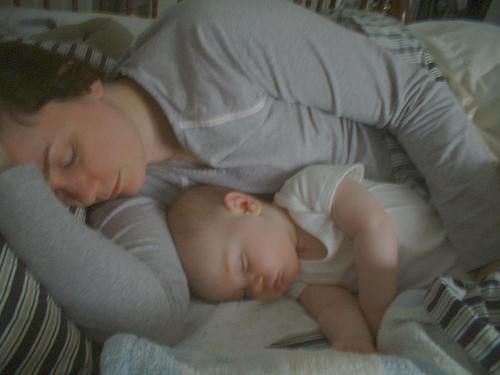
There are many parents who have problems getting their children to sleep well. Sleep disorders affect many children and parents are the most affected, so they are looking for effective methods to improve the sleep of their little ones.
Currently there are two main currents that are quite opposed to each other: the educational current that considers that sleeping well is one more habit that the child must learn ( Dr. Estivill is its greatest exponent) and the naturalistic current that considers sleeping an evolutionary process that children will adopt naturally, without the need to learn to do so. In today’s post we will talk about the technique most used today by supporters of this second trend: co-sleeping.
Co-sleeping as its name suggests (co-bed) consists of sharing the bed with the baby, there are several ways: sleeping all night with him, sleeping alone in the first phase of sleep and then leaving him in the crib or sleeping with the baby only if he wakes up crying.
Supporters of co-sleeping point out that this practice has multiple BENEFITS for both the baby and the parents:
- Children have a greater sense of security when in contact with the mother’s skin.
- The baby’s breathing synchronizes with the mother’s so it goes from one phase of sleep to another naturally.
- The baby’s body temperature is better regulated.
- It’s a great way to spend more time with your baby, especially if you work during the day.
- Moms have to get up fewer times at night to breastfeed , so they sleep more.
- Babies who sleep with their parents stay up less late and cry less during the night.
But like any trend, this technique has detractors who point out that co-sleeping has more DISADVANTAGES than advantages:
- There is a great danger of crushing, especially if the baby is a newborn, or of getting trapped between the sheets.
- There are many pediatricians who argue that, despite what is believed, co-sleeping increases the risk of sudden death. In fact, it is not recommended to sleep with premature babies.
- The moment of transition between the parents’ bed and one’s own bed is very difficult.
- If the child gets used to sleeping with the parents, when he grows up it will be difficult for him to fall asleep without them. Even if, for example, one day the parents want to go out at night this is a big problem because the child will not fall asleep without them.
- The intimate life of the couple disappears completely.
This practice is becoming so frequent that Unicef has published a manual with some BASIC RULES FOR PRACTICING CO-SLEEPING:
- The bed should be quite spacious.
- It is important that the mattress is firm so that no gaps are created where the child can be trapped.
- Make sure that it is impossible for the child to fall or otherwise get trapped between the mattress and the wall.
- The baby’s head can never be covered.
- Do not use heavy bedding, such as duvets, or with bows.
- Do not place cushions on the bed.
- The baby should never sleep on his stomach.
- Never sleep on the sofa, if you are going to sleep with the baby, always be in bed.
- If the adult smokes, has taken alcohol or drugs, it is preferable that he or she does not lie down next to the baby.
- If the adult suffers from obesity, this practice is not recommended either.
And you? Are you for or against co-sleeping?